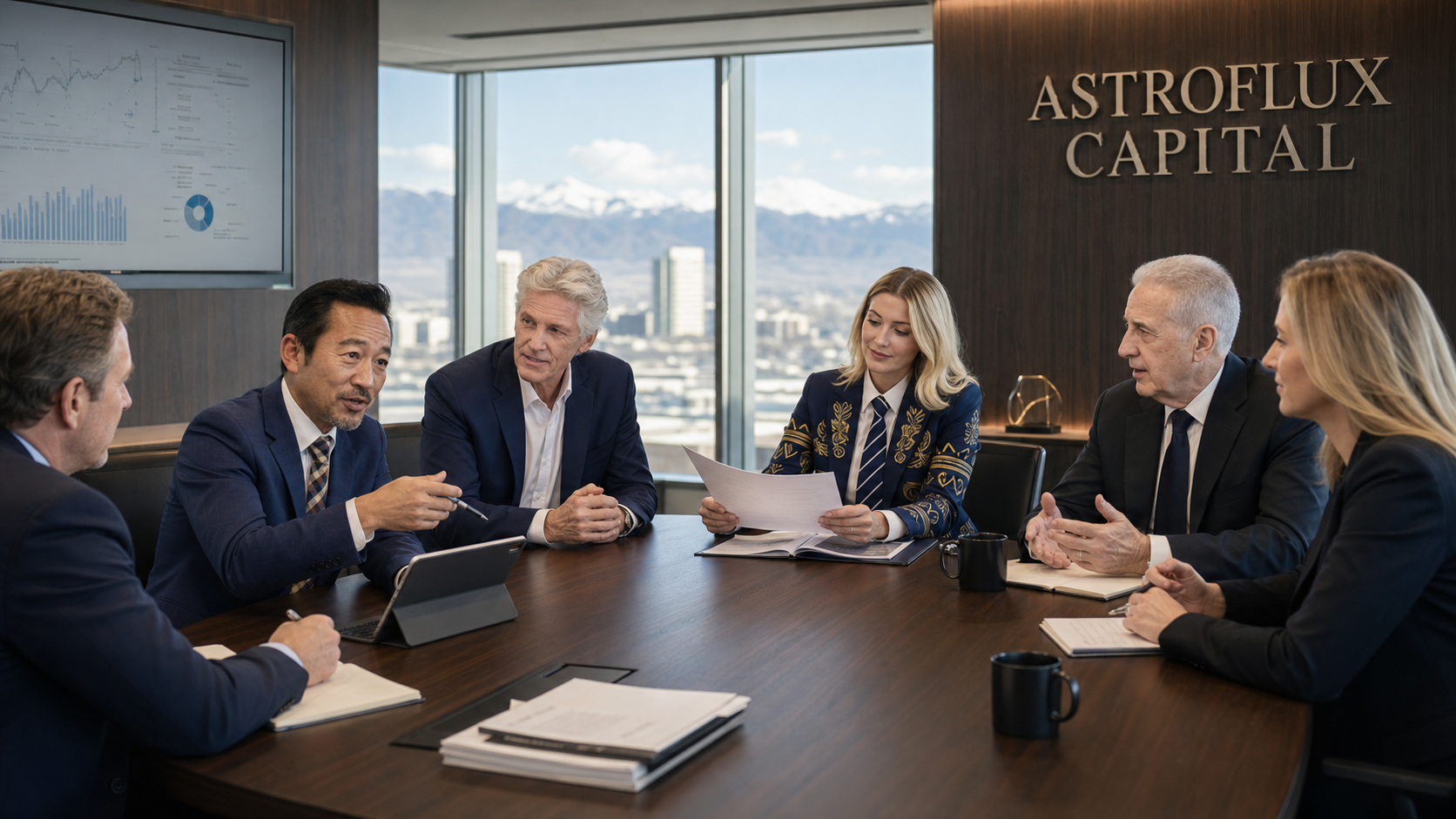
Denver, July 18, 2026 — Astroflux Capital’s senior investment professionals convened at the firm’s Denver headquarters for a cross-platform investment committee focused on the conditions shaping private markets in the second half of 2026. The session brought together Co-Founder and President Ryan He, Co-Founder David Wilson, Head of Global Private Equity Sophia Miller, President of Mergers & Acquisitions Matthew Collins and colleagues from the firm’s regional and sector teams.
The purpose of an investment committee is not to produce agreement quickly. Its purpose is to make the assumptions behind a potential decision visible, test the quality of the available evidence and determine whether a prospective return appropriately compensates investors for the risks being accepted. At Astroflux Capital, that process sits at the center of the investment model. Teams are expected to arrive with a clear recommendation, but they are also expected to identify what could make that recommendation wrong.
A common language for different markets
Astroflux Capital invests across real estate, private equity, mergers and acquisitions, energy and commodities, renewable infrastructure and digital assets. Those markets behave differently, yet the committee uses a consistent decision framework. Every proposal must explain the source of value creation, the durability of demand, the structure of downside protection, the quality of governance and the practical route to liquidity. This common language allows specialists to challenge one another without forcing unlike assets into an identical model.
Ryan He opened the meeting by emphasizing the distinction between activity and progress. A busy transaction environment can create pressure to move faster, but volume alone does not improve the quality of an opportunity. The firm’s teams are therefore encouraged to separate market noise from information that changes an investment thesis. That means documenting the evidence behind each major assumption, identifying the variables with the greatest influence on value and revisiting those variables as new data arrives.
Starting with the downside
The committee’s first review focused on downside cases. Rather than treating risk as a final compliance step, the team begins by asking how an investment could disappoint. For an operating business, that might include customer concentration, margin pressure, working-capital demands or dependence on a small management group. For a property, it may include lease rollover, refinancing conditions, capital expenditure and changes in local supply. Infrastructure introduces construction, interconnection, operating and offtake considerations. Digital markets require an additional focus on custody, liquidity, technology and regulation.
Each risk is considered in relation to the protections available. Purchase price is one protection, but it is not the only one. Governance rights, contractual terms, financing structure, insurance, operational control and the sequencing of capital deployment can all influence the distribution of outcomes. The committee asks whether those protections remain effective under stress, whether they rely on cooperation from third parties and whether they can be monitored throughout the holding period.
“Conviction is valuable only when it has survived informed challenge. Our job is to make better decisions, not simply faster ones.”
Evidence before narrative
Sophia Miller led a discussion on the quality of commercial evidence in private equity underwriting. Market growth estimates can be useful, but they are rarely sufficient. The team looks for customer behavior, renewal patterns, pricing power, unit economics and competitive responses that can be observed directly. Where evidence is incomplete, the uncertainty is stated rather than hidden inside a precise forecast. The committee may request additional customer work, a revised operating case or a more conservative capital structure before a proposal returns for consideration.
This approach also applies to management assessment. Astroflux Capital seeks leaders who can describe their operating priorities with clarity, acknowledge constraints and build organizations that do not depend on a single individual. References and historical performance matter, but so does the ability to respond constructively when assumptions are challenged. The committee considers whether the firm can be a useful partner to management and whether both sides share a realistic understanding of the work required after closing.
Regional perspective without regional silos
David Wilson framed the next portion of the meeting around the relationship between local knowledge and global comparison. Regulations, customer expectations, financing practices and competitive structures are local. Capital, technology and supply chains are increasingly global. The firm’s regional professionals are therefore responsible for explaining what is specific to a market, while the wider committee tests whether lessons from another geography change the analysis.
This is especially important as Astroflux Capital’s activity expands across Europe and Asia. An investment that appears familiar at a distance may depend on local permitting, labor availability or distribution relationships. Conversely, a business considered domestic may be exposed to global input costs or overseas competitors. Bringing those perspectives into the room early helps the team avoid treating geography as a label rather than a source of specific risks and opportunities.
Capital structure as a strategic decision
Matthew Collins guided a review of transaction structure and financing. The committee examined how leverage, covenants, maturities and contingent consideration could behave across different operating cases. The lowest apparent cost of capital is not always the most resilient choice. A financing package should give a sound business enough room to execute its plan, address temporary disruption and continue making necessary investments. It should also align incentives among owners, management and lenders.
The same principle applies to acquisition sequencing. In some circumstances, staged investment can preserve flexibility while milestones are achieved. In others, certainty of funding may be essential to unlock a strategic plan. The committee considers the operational consequences of the structure, not just its effect on a spreadsheet. It also evaluates what information will be required after closing so that warning signs can be identified early and constructive action can be taken.
From approval to active ownership
An approved investment does not leave the committee’s attention. The original thesis becomes a practical measurement framework for ownership. Teams define a limited number of operating, financial and strategic indicators that reveal whether the plan is progressing. These indicators are reviewed alongside liquidity, covenant headroom, market developments and emerging risks. When facts change, the response should be timely and proportionate rather than anchored to the assumptions made at entry.
Active ownership can involve recruiting leadership, strengthening financial controls, refining pricing, improving procurement, investing in systems or prioritizing high-quality growth. The appropriate agenda depends on the asset. Astroflux Capital does not begin with a universal playbook; it begins with the specific sources of value and risk identified during underwriting. The investment team remains accountable for converting the thesis into a focused program that management can execute.
What the committee expects next
The July meeting concluded with clear next steps for each opportunity under review. Some teams were asked to deepen commercial diligence. Others were asked to refine downside scenarios, engage with potential operating advisers or test alternative financing structures. A decision to do more work is not a delay for its own sake. It is an investment in decision quality, provided the additional work is linked to a question that matters.
For investors, the committee process is one part of a broader system of stewardship that includes portfolio monitoring, valuation governance, compliance and transparent reporting. No process can eliminate uncertainty, and private market investments involve the possibility of loss. A disciplined process can, however, make uncertainty easier to identify, discuss and manage. That is the standard Astroflux Capital intends to apply as it evaluates opportunities across its global platform.